

You’re embarking on a construction project, and durability is paramount. You’ve decided on masonry and concrete as your foundational materials, a wise choice given their inherent strength and longevity. But the world of construction materials isn’t static. To ensure your project stands the test of time, it’s crucial to understand the modern trends shaping masonry and concrete, pushing the boundaries of their performance and application. This article will guide you through these advancements, focusing on how they contribute to more durable and sustainable built environments.
The concrete you’re familiar with – a mix of cement, aggregate, and water – has evolved. What were once considered esoteric additives are now becoming standard practice, enhancing its core properties and introducing entirely new functionalities. You’ll find that understanding these compositional changes is key to selecting the right concrete for your specific needs.
Advanced Cementitious Materials
The Portland cement that forms the backbone of traditional concrete is being supplemented and sometimes replaced by advanced cementitious materials. These are often byproducts of other industries, offering both environmental and performance benefits.
Supplementary Cementitious Materials (SCMs)
You might encounter materials like fly ash, slag cement (ground granulated blast furnace slag or GGBFS), and silica fume. These fine powders react with the calcium hydroxide produced during cement hydration, forming additional calcium silicate hydrate (CSH) – the glue that binds concrete.
- Fly Ash: A byproduct of coal combustion, fly ash improves workability, reduces permeability, and enhances long-term strength and durability. It can also lower the heat of hydration, making it suitable for large pours where thermal cracking is a concern.
- Slag Cement: Derived from the steel manufacturing process, slag cement offers similar benefits to fly ash, including improved resistance to sulfate attack and chloride penetration. Its slow pozzolanic reaction contributes to significant long-term strength gain.
- Silica Fume: A byproduct of silicon metal production, silica fume is exceptionally fine. Its addition dramatically increases strength and reduces permeability, making it ideal for high-performance concrete applications like bridge decks and parking structures. However, it can impact workability, often requiring the use of superplasticizers.
Geopolymer Concrete
A more radical departure is geopolymer concrete. Instead of Portland cement, it uses alkali-activated aluminosilicate materials, often industrial byproducts like fly ash or slag, reacted with alkaline solutions.
- Environmental Advantages: Geopolymer concrete production can result in significantly lower greenhouse gas emissions compared to traditional Portland cement concrete.
- Performance Benefits: It can exhibit excellent strength, fire resistance, and resistance to acids and sulfates, making it a compelling alternative for specific applications. However, the long-term performance data is still accumulating, and the curing process can be more complex.
Nanotechnology in Concrete
The application of nanotechnology is pushing the performance envelope of concrete to microscopic levels. You’ll find that even small additions of nano-materials can have a profound impact.
Carbon Nanotubes and Nanoparticles
The incorporation of materials like carbon nanotubes (CNTs) or nano-silica is being explored. These tiny particles can reinforce the concrete matrix at the molecular level, increasing tensile strength, fracture toughness, and durability.
- Enhanced Mechanical Properties: Early research indicates significant improvements in compressive and tensile strength, as well as reduced cracking.
- Improved Durability: Nanomaterials can also create a more tortuous path for aggressive substances like chlorides and sulfates to penetrate the concrete, thus enhancing its resistance to chemical attack and corrosion of reinforcing steel.
Self-Healing Concrete
This is perhaps one of the most exciting advancements. Self-healing concrete incorporates agents that can autonomously repair cracks as they form, significantly extending the service life of structures.
- Encapsulated Healing Agents: This typically involves embedding microcapsules filled with healing agents (e.g., epoxy resins, polyurethane, or bacterial spores) within the concrete matrix. When a crack forms, it ruptures the capsules, releasing the agent to fill and seal the crack.
- Bacterial Self-Healing: A more bio-inspired approach uses specific bacteria that, when exposed to water and oxygen within a crack, precipitate calcium carbonate, effectively sealing the fissure.
Advances in Masonry Materials and Techniques
Masonry, with its inherent beauty and resilience, is also undergoing modernization. The way we produce and utilize masonry units, as well as the mortars that bind them, are seeing significant innovation.
High-Performance Masonry Units
Beyond traditional clay bricks and concrete blocks, you’ll find a growing array of masonry units designed for specific performance requirements.
Engineered Masonry
These units are manufactured with precise control over their composition and dimensions to achieve enhanced properties.
- Lightweight Concrete Masonry Units: Incorporating expanded clay, shale, or perlite reduces the density of concrete blocks, easing handling and transport while still offering good structural and insulating properties. They can also lead to reduced seismic loads.
- Autoclaved Aerated Concrete (AAC): AAC blocks are lightweight, pre-cast units made from sand, cement, lime, gypsum, and an expansion agent. They offer excellent thermal insulation, fire resistance, and are easy to cut and shape, leading to faster construction times.
- Fibre-Reinforced Masonry (FRM): Incorporating fibres such as glass, steel, or synthetic polymers into masonry units can significantly improve their tensile strength, flexural capacity, and resistance to cracking.
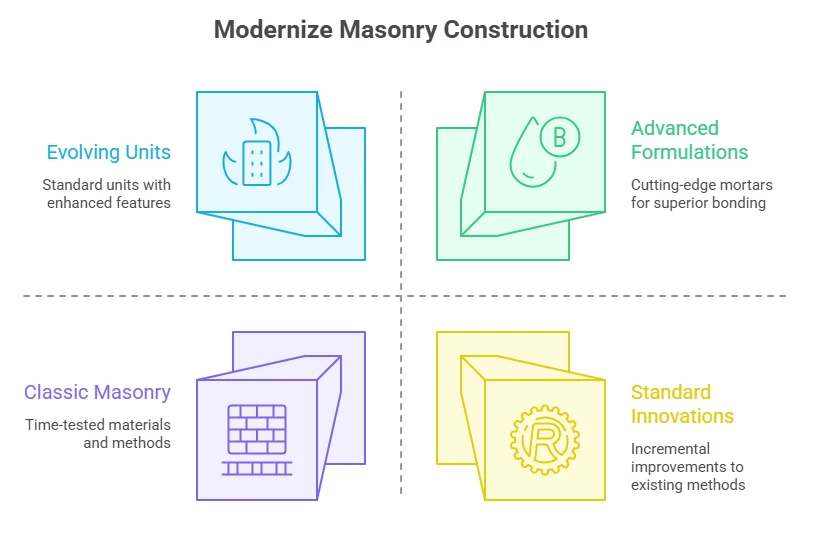
Advanced Mortar Formulations
The mortar is as critical as the masonry unit itself in ensuring durability. Modern mortars are formulated to meet specific performance criteria beyond simple adhesion.
Polymer-Modified Mortars
These mortars incorporate polymers, such as acrylics or epoxies, to enhance their properties.
- Improved Adhesion and Flexibility: Polymers increase the bond strength between the mortar and the masonry unit, reducing the likelihood of cracking and improving overall system resilience.
- Enhanced Water Resistance and Durability: They can also improve resistance to freeze-thaw cycles, chemical attack, and reduce water penetration.
- Self-Compacting Mortars: These are designed to flow and fill voids without manual consolidation, ensuring better bond and reducing the risk of honeycombing, particularly in areas with complex reinforcement or closely spaced units.
Thin-Bed Mortars
For highly accurate masonry units, such as those used in AAC construction, thin-bed mortars are employed. These are applied in very thin layers, requiring less material and leading to faster construction.
- High Bond Strength: Despite their thinness, these mortars are formulated for exceptional bond strength, ensuring the integrity of the masonry assembly.
- Reduced Thermal Bridging: The thin layer of mortar minimizes thermal bridging compared to traditional thicker mortar joints.
Integrating Masonry and Concrete for Enhanced Performance
The true power of modern construction often lies in the intelligent combination of materials. You’ll see trends where masonry and concrete are no longer treated as independent entities but as integrated systems.
Composite Masonry and Concrete Structures
This involves designing buildings where masonry and concrete work in tandem to achieve superior structural and aesthetic outcomes.
Reinforced Masonry with Concrete Infill
This technique builds upon traditional reinforced masonry by filling the cavity or cores of masonry units with concrete.
- Increased Strength and Stability: The concrete infill significantly enhances the compressive and shear strength of the masonry wall, making it more resistant to lateral loads like wind and seismic forces.
- Improved Fire Resistance: The concrete core can also contribute to better fire performance.
Concrete Frames with Masonry Cladding
A common and effective approach involves constructing a concrete structural frame and then cladding it with masonry.
- Structural Independence: The concrete frame provides the primary load-bearing capacity, while the masonry acts as a non-load-bearing facade, offering aesthetic appeal, insulation, and weather protection.
- Design Flexibility: This allows for a wide range of architectural expressions with masonry while benefiting from the predictability and strength of concrete framing.
Precast and Prefabricated Systems
The construction industry is increasingly embracing off-site fabrication, and this extends to both masonry and concrete elements.
Precast Concrete Elements
You’ll find precast concrete panels, beams, columns, and even entire wall systems being manufactured in controlled factory environments.
- Quality Control and Consistency: Factory production ensures consistent material quality and dimensional accuracy, leading to fewer on-site errors and improved durability.
- Speed of Construction: Precast elements can be rapidly assembled on-site, significantly reducing construction timelines.
Prefabricated Masonry Panels
Similarly, masonry walls can be constructed in panels off-site using engineered masonry units and advanced mortars.
- Controlled Environment Curing: Mortars and grouts cure under ideal conditions, leading to optimal strength and durability.
- Reduced On-Site Labour: Assembly on-site is faster and requires less specialized labour.
Durability Through Advanced Protective Systems
Even the most robust masonry and concrete can benefit from protective measures that enhance their lifespan and resistance to environmental degradation.
Advanced Coatings and Sealants
The application of specialized coatings and sealants acts as a barrier against the ingress of harmful substances.
Penetrating Sealers
These sealers soak into the pores of the concrete or masonry, providing protection without altering the surface appearance significantly.
- Water Repellency: They reduce water absorption, which is crucial for preventing freeze-thaw damage and efflorescence (salt deposits).
- Chloride and Sulfate Resistance: Many penetrating sealers offer protection against the ingress of chlorides (from de-icing salts or marine environments) and sulfates, which can cause significant deterioration.
Breathable Membranes and Coatings
For certain applications, especially where moisture vapor transmission is a concern, breathable coatings are essential.
- Moisture Management: These coatings allow water vapor to escape from within the structure while preventing liquid water ingress, thus mitigating issues like mould growth and delamination.
- Aesthetic Options: Available in a wide range of finishes, from clear to pigmented, they can also enhance the visual appeal of the construction.
Corrosion-Resistant Reinforcement
The corrosion of steel reinforcement is a primary cause of premature failure in concrete structures. Modern trends are focusing on mitigating this risk.
Epoxy-Coated Rebar
Steel rebar coated with an epoxy layer acts as a barrier against moisture and chlorides.
- Extended Service Life: While not impervious, it significantly delays the onset of corrosion compared to uncoated rebar, particularly in aggressive environments.
Stainless Steel Rebar
For the most demanding applications, stainless steel rebar offers superior corrosion resistance.
- Long-Term Durability: Its inherent resistance to rust makes it an excellent choice for structures exposed to high levels of chlorides, such as bridges, marine structures, and parking garages. However, it comes at a higher initial cost.
Fibre-Reinforced Polymer (FRP) Rebar
FRP rebars, made from materials like glass or carbon fibres embedded in a polymer matrix, are non-metallic and therefore immune to electrochemical corrosion.
- Lightweight and High Strength: FRP rebars are lighter than steel and offer comparable or even superior tensile strength.
- Electromagnetic Neutrality: They are also non-conductive, which can be an advantage in certain applications, such as structures near high-voltage equipment.
Sustainable Practices and Material Life Cycles
| Construction Trend | Key Metrics |
|---|---|
| Increased Use of Masonry | Rise in masonry construction projects by 15% in the last 5 years |
| Concrete Innovations | Adoption of high-performance concrete in 30% of new construction projects |
| Sustainability in Masonry | 30% increase in demand for sustainable masonry materials |
| Efficiency in Concrete Work | Reduction of construction time by 20% through advanced concrete techniques |
The emphasis on sustainability in construction is not just about environmental impact but also about building for the long term, reducing the need for frequent repairs and replacements, which are inherently resource-intensive.
Use of Recycled and Reclaimed Materials
You’ll find a growing movement towards incorporating recycled content into masonry and concrete.
Recycled Aggregates
Crushed concrete, asphalt, and glass can be processed and used as aggregates in new concrete mixes.
- Resource Conservation: This reduces the demand for virgin aggregate extraction, conserving natural resources and reducing landfill waste.
- Performance Considerations: Depending on the source and processing, recycled aggregates can be used in structural applications, though some limitations may apply depending on the specific project requirements.
Reclaimed Masonry
Old bricks and stone can be salvaged, cleaned, and reused in new construction.
- Aesthetic Charm and Sustainability: This not only provides unique architectural character but also diverts materials from landfill.
- Quality Assessment: Careful inspection and grading are necessary to ensure the structural integrity and performance of reclaimed masonry.
Designing for Deconstruction and Material Recovery
The future of durable construction also involves planning for the end of a building’s life cycle.
Modular Construction and Design for Disassembly
Designing structures with modular components that can be easily disassembled allows for the recovery and reuse of materials at the end of the building’s service life.
- Circular Economy Principles: This aligns with circular economy principles, minimizing waste and maximizing the value of materials.
- Facilitated Renovations and Upgrades: A modular approach can also make future renovations or upgrades more straightforward.
Life Cycle Assessment (LCA)
Understanding the environmental impact of materials and construction processes throughout their entire life cycle is becoming standard practice.
- Informed Material Selection: LCA helps you make informed decisions about material choices, considering embodied energy, greenhouse gas emissions, and resource depletion from extraction to disposal.
- Optimizing for Longevity: By considering the full life cycle, you can prioritize materials and designs that offer greater durability and require less maintenance, ultimately reducing the overall environmental footprint.
As you navigate the complexities of selecting and specifying materials for your next project, remember that the field of masonry and concrete is continually evolving. By staying informed about these modern trends, you can make choices that not only ensure the immediate structural integrity of your building but also contribute to its long-term durability, sustainability, and resilience for generations to come.
FAQs
What are the current trends in modern masonry and concrete work for durable construction?
The current trends in modern masonry and concrete work for durable construction include the use of sustainable and eco-friendly materials, advanced reinforcement techniques, and innovative design approaches to enhance durability and longevity of structures.
How are sustainable and eco-friendly materials being incorporated into modern masonry and concrete work?
Sustainable and eco-friendly materials such as recycled aggregates, fly ash, and slag cement are being used to reduce the environmental impact of masonry and concrete work. These materials help in conserving natural resources and reducing carbon emissions.
What are some advanced reinforcement techniques being used in modern masonry and concrete work?
Advanced reinforcement techniques such as the use of fiber-reinforced concrete, high-strength steel bars, and pre-stressed concrete are being employed to enhance the structural integrity and durability of masonry and concrete structures.
How are innovative design approaches contributing to durable construction in modern masonry and concrete work?
Innovative design approaches such as the incorporation of seismic-resistant features, modular construction systems, and 3D printing technology are being utilized to improve the durability and resilience of masonry and concrete structures.
What are the benefits of incorporating these modern trends into masonry and concrete work for durable construction?
Incorporating these modern trends into masonry and concrete work leads to enhanced durability, reduced maintenance costs, improved energy efficiency, and overall sustainability of construction projects.


