
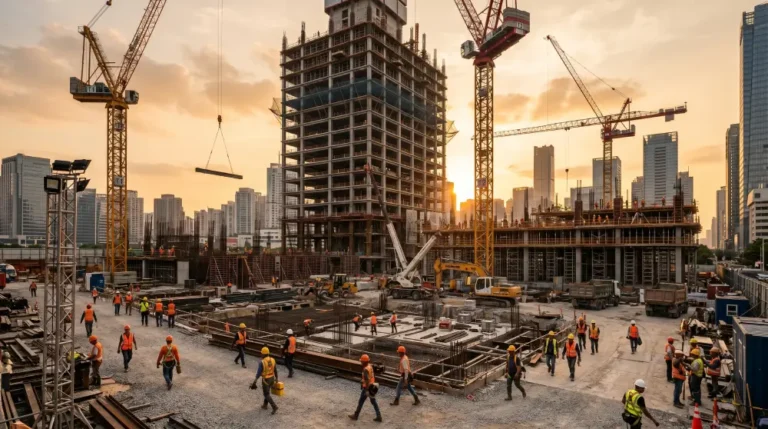

Construction project management is the backbone of every successful build. Whether the goal is raising a residential home, a commercial tower, or a large-scale infrastructure project, the discipline of managing construction projects determines whether a project comes in on time, within budget, and to the expected standard of quality. Without a solid management framework, even the most well-funded construction efforts can spiral into delays, cost overruns, and legal disputes.
This guide walks through the core principles, phases, tools, and best practices of construction project management, helping both professionals and clients understand what it takes to bring a building project from concept to completion.
- What Is Construction Project Management?
- The Key Phases of Construction Project Management
- Core Responsibilities of a Construction Project Manager
- Essential Tools and Technologies in Modern Construction Management
- The Importance of Contract Management
- Safety Management on Construction Sites
- Sustainability in Construction Project Management
- Common Challenges in Construction Project Management
- Best Practices for Successful Construction Project Management
- Conclusion
- FAQs
What Is Construction Project Management?
Construction management is a professional service that uses specialized project management techniques to oversee the planning, design, and construction of a project from its beginning to its end. The goal is to control a project’s time, cost, quality, scope, function, and risk factors.
At its core, construction project management involves coordinating people, resources, contracts, and timelines so that a construction project runs smoothly. A construction project manager acts as the central point of communication between the client, architects, engineers, subcontractors, and regulatory authorities.
The role is complex because construction projects are inherently multi-layered. They involve dozens or even hundreds of stakeholders, thousands of moving parts, and strict legal and safety requirements that must be met at every stage.
The Key Phases of Construction Project Management
Understanding the lifecycle of a construction project is fundamental to managing it well. Most construction projects follow a sequence of well-defined phases.
Project Initiation
This is where every construction project begins. The client defines the need, the scope is broadly outlined, and feasibility studies are conducted. During initiation, project managers work closely with clients to understand their goals, constraints, and expectations. A project charter is often created to formally authorize the project.
Planning
Planning is arguably the most critical phase of construction project management. According to research from the Project Management Institute, thorough planning significantly reduces the risk of project failure. In this phase, the project manager develops the project plan, which includes the schedule, budget, resource allocation, communication strategy, and risk management plan.
A work breakdown structure (WBS) is often used to divide the project into manageable tasks. Each task is then assigned a timeline, responsible party, and resource requirement. The planning phase also includes obtaining necessary permits and approvals from local authorities.
Design and Pre-Construction
Once planning is approved, detailed designs are created by architects and engineers. The project manager coordinates these teams to ensure the designs align with the client’s vision and the allocated budget. During pre-construction, the site is prepared, procurement processes begin, and subcontractors are selected through competitive bidding.
Execution and Construction
This is where physical construction takes place. The project manager oversees day-to-day operations, monitors progress against the schedule, manages subcontractors, ensures materials arrive on time, and addresses issues as they arise. Regular site inspections and progress meetings are conducted to keep everything on track.
Quality control is a major focus during execution. The project manager ensures that all work meets the required specifications, codes, and standards before moving to the next phase.
Monitoring and Controlling
Running in parallel with execution, the monitoring and controlling phase involves tracking project performance using key performance indicators (KPIs). Cost variance, schedule variance, and quality metrics are reviewed regularly. When deviations are identified, corrective actions are taken promptly to bring the project back in line with the original plan.
Project Closeout
Once construction is complete, the closeout phase begins. This involves conducting a final inspection, obtaining completion certificates, handing over the finished structure to the client, and resolving any outstanding punch list items. Documentation is compiled, lessons learned are recorded, and the project team is released.
Core Responsibilities of a Construction Project Manager
A construction project manager wears many hats throughout a project. Their responsibilities span technical, administrative, and interpersonal domains.
Scope management ensures the project delivers exactly what was agreed upon, preventing scope creep that leads to budget overruns. Cost management involves creating accurate budgets, tracking expenditures, and forecasting future costs. Time management requires developing realistic schedules and making adjustments when delays occur.
Risk management is equally vital. Identifying potential risks early, such as weather delays, supply chain disruptions, or design changes, allows the project team to develop mitigation strategies before problems escalate. Quality management ensures that every aspect of the construction meets contractual standards and local building codes.
Communication is perhaps the most underestimated responsibility. A construction project manager must maintain clear, consistent communication across a wide range of stakeholders. Miscommunication is one of the leading causes of construction disputes, delays, and rework.
Essential Tools and Technologies in Modern Construction Management
The construction industry has embraced technology to improve project outcomes. Modern construction project managers rely on a suite of digital tools to plan, monitor, and report on projects.
Project management software such as Procore, Autodesk Construction Cloud, and Microsoft Project enables teams to track tasks, share documents, and communicate in real time. Building Information Modeling (BIM) has transformed how construction teams visualize and coordinate complex projects, allowing architects, engineers, and contractors to collaborate on a single digital model before construction begins.
Drone technology is increasingly used for site surveys and progress monitoring. Drones can capture aerial footage of the site, track material deliveries, and identify safety hazards far more efficiently than traditional methods.
Mobile applications allow field teams to capture and report data from the site in real time, reducing the lag between on-site events and management decisions. This real-time visibility is critical for keeping projects on schedule and within budget.
The Importance of Contract Management
Construction contracts are the legal foundation of every project. A well-drafted contract protects all parties, clearly defines responsibilities, outlines payment terms, and establishes procedures for handling changes, disputes, and delays.
There are several common types of construction contracts, including lump-sum contracts, cost-plus contracts, and unit price contracts. Each has its own risk profile and is suited to different project types and client-contractor relationships.
Effective contract management involves regularly reviewing contract terms, tracking deliverables, issuing and responding to change orders promptly, and maintaining thorough records of all communications and decisions. Poorly managed contracts are a major source of construction claims and litigation.
Safety Management on Construction Sites
Safety is a non-negotiable pillar of construction project management. Construction sites are among the most hazardous work environments, and project managers bear a significant responsibility for the safety of all workers on site.
According to the Occupational Safety and Health Administration (OSHA), the “Fatal Four” construction hazards, which include falls, being struck by objects, electrocution, and being caught in or between equipment, account for the majority of construction fatalities. A robust safety management plan addresses these risks through training, protective equipment, site organization, and regular safety audits.
Safety is not only a moral obligation but also a business one. Projects with poor safety records face regulatory fines, insurance complications, and reputational damage that can significantly affect future business.
Sustainability in Construction Project Management
Sustainable construction is no longer optional. Clients, governments, and communities increasingly demand that construction projects minimize their environmental impact. Project managers play a critical role in embedding sustainability into every phase of a project.
This includes sourcing eco-friendly materials, designing for energy efficiency, minimizing waste, and managing the environmental impact of construction activities. Green building certifications such as LEED (Leadership in Energy and Environmental Design) provide a structured framework for achieving and demonstrating sustainability goals.
Research from Massachusetts Institute of Technology (MIT) highlights that sustainable construction practices can reduce long-term operating costs significantly while contributing to healthier built environments. Integrating sustainability from the early planning stages, rather than adding it as an afterthought, yields the greatest benefits.
Common Challenges in Construction Project Management
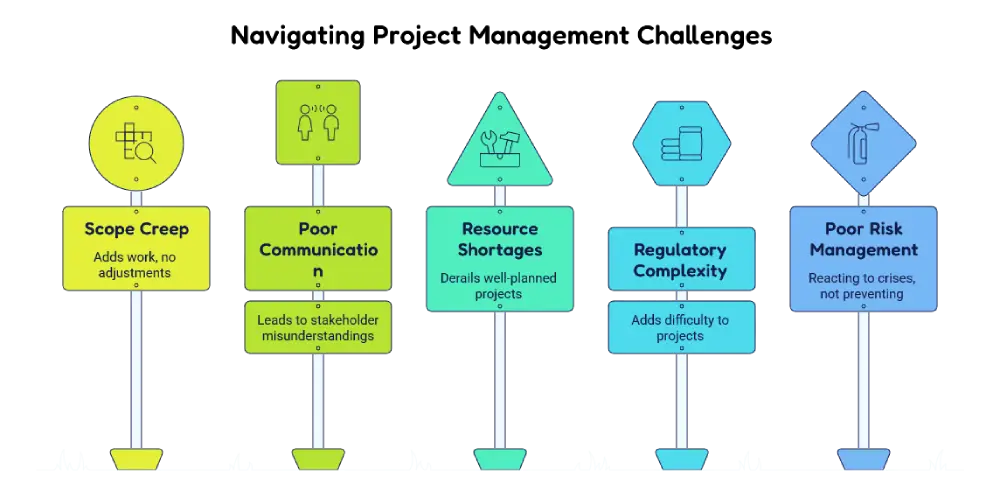
Even the most experienced project managers encounter challenges. Understanding these pitfalls helps teams prepare for and navigate them more effectively.
Scope creep occurs when additional work is added to the project without adjusting the budget or timeline. Poor communication leads to misunderstandings between stakeholders. Labour shortages, supply chain disruptions, and rising material costs can derail even well-planned projects.
Regulatory complexity adds another layer of difficulty, particularly in large urban projects where multiple permits, inspections, and compliance requirements must be managed simultaneously. Poor risk management leaves teams reacting to crises rather than preventing them.
Best Practices for Successful Construction Project Management
Successful construction project management comes down to a combination of technical expertise, strong leadership, and proactive planning. Establishing clear goals at the outset ensures that every team member understands the project vision. Building a competent, experienced team and maintaining open lines of communication reduces the risk of costly errors.
Embracing technology, investing in professional development, and learning from past projects are habits that distinguish consistently successful project managers from the rest. Equally important is building strong relationships with subcontractors, suppliers, and regulatory authorities, as these relationships often determine how smoothly a project runs when unexpected challenges arise.
Conclusion
Construction project management is a discipline that demands equal parts technical knowledge, strategic thinking, and people skills. From the initial feasibility study to the final handover, every decision a project manager makes shapes the outcome of the project. By following proven frameworks, leveraging the right tools, prioritizing safety and sustainability, and maintaining strong communication, construction project managers can deliver projects that meet or exceed client expectations.
As the built environment grows increasingly complex, the demand for skilled construction project managers will only continue to rise. Investing in this discipline is investing in the future of construction itself.
FAQs
What is construction project management?
Construction project management is a professional discipline that involves planning, coordinating, and overseeing all aspects of a construction project from start to finish. It covers scope, budget, schedule, quality, safety, and communication to ensure the project is delivered successfully and meets the client’s expectations.
What are the main phases of construction project management?
The main phases include project initiation, planning, design and pre-construction, execution, monitoring and controlling, and project closeout. Each phase plays a critical role in keeping the project on track, within budget, and aligned with the agreed scope and quality standards.
What does a construction project manager do?
A construction project manager is responsible for coordinating teams, managing budgets and schedules, handling contracts, overseeing subcontractors, ensuring safety compliance, and maintaining clear communication between all stakeholders including clients, architects, engineers, and regulatory authorities throughout the life of a project.
What tools are used in construction project management?
Modern construction project managers use a range of digital tools including project management software like Procore and Autodesk Construction Cloud, Building Information Modeling (BIM) platforms, drone technology for site monitoring, and mobile applications that allow field teams to report data in real time for faster decision making.
What are the biggest challenges in construction project management?
The most common challenges include scope creep, poor communication between stakeholders, labour and material shortages, rising costs, regulatory complexity, and inadequate risk planning. Addressing these challenges early through thorough planning, strong contracts, and proactive communication significantly improves the chances of project success.


